WASHINGTON, D.C., Feb. 3, 2026 — The Alzheimer’s Impact Movement (AIM) and the Alzheimer’s Association welcomed final congressional approval and the president’s signature on the fiscal year (FY) 2026 spending package that secures a $100 million increase for Alzheimer’s and dementia research at the National Institutes of Health (NIH). The spending package also includes $41.5 million to implement the BOLD Infrastructure for Alzheimer’s Act at the Centers for Disease Control and Prevention (CDC) — marking another major step forward in the national effort to confront one of the most urgent public health challenges facing the country.
With the $100 million funding increase now finalized, the total annual federal investment in Alzheimer’s and dementia research will be approximately $3.9 billion. The BOLD funding represents the highest annual investment since the law was enacted, strengthening the nation’s public health response to Alzheimer’s and other dementia in communities across the country.
“By finalizing this increase, our nation’s leaders are choosing progress in the fight against Alzheimer’s and other dementia,” said Robert Egge, Alzheimer’s Association chief public policy officer and AIM president. “This funding helps move science forward and brings us closer to better ways to prevent, detect, treat, and care for dementia.”
The additional NIH funding will support research across the full spectrum of Alzheimer’s and dementia science — from understanding disease mechanisms and identifying biomarkers, to advancing prevention strategies and developing more effective treatments and care approaches. Increased funding for the BOLD Infrastructure for Alzheimer’s Act will further strengthen state and community capacity to reduce risk factors, promote early detection and diagnosis, support caregivers, and improve outcomes for people living with dementia.
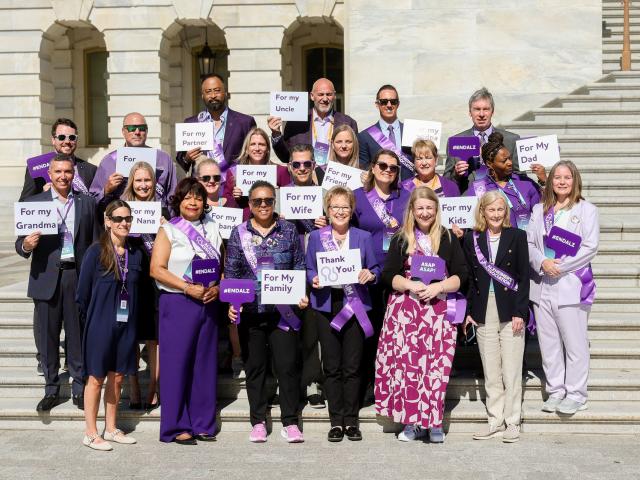
This progress was made possible by years of sustained advocacy from people impacted by Alzheimer’s and other dementia, who worked tirelessly to build bipartisan support in Congress. Throughout the year, AIM advocates from all 50 states engaged lawmakers through meetings, emails, phone calls and social media outreach — sharing their personal stories and urging Congress to act. Their voices played a critical role in ensuring Alzheimer’s and dementia research remained a priority throughout the appropriations process.
“Families and advocates have grown bipartisan support in Congress, and it has driven progress against Alzheimer’s and other dementia for more than a decade,” Egge added. “This increase honors those voices and keeps the work moving toward new treatments and a cure.”
More than 7 million Americans are currently living with Alzheimer’s disease, with millions more acting as caregivers or loved ones. As the nation’s population ages, these numbers are expected to grow, underscoring the urgency of sustained and robust federal investment in research and public health infrastructure.