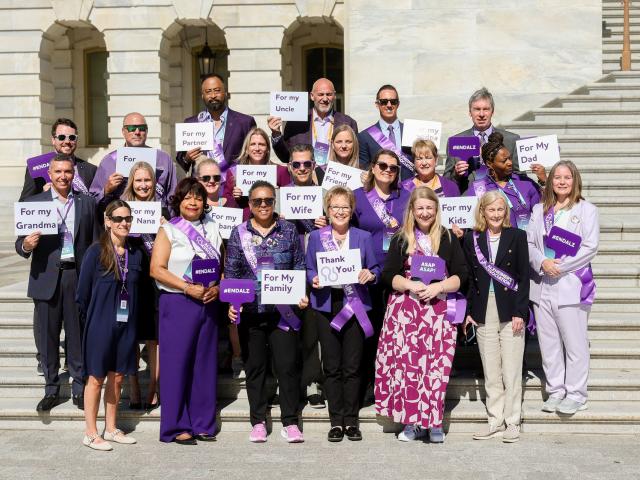
Washington, D.C., May 21, 2026 — The Alzheimer’s Association and the Alzheimer’s Impact Movement (AIM) applaud the House Energy and Commerce Committee for voting today to advance the bipartisan Accelerating Access to Dementia & Alzheimer’s Provider Training (AADAPT) Act. The vote builds on the bill’s recent passage through the Subcommittee on Health, bringing it one step closer to the House floor.
“We are at a turning point in Alzheimer’s care — new treatments and new diagnostic tests are available, but that progress only matters if the providers caring for them have the tools they need to meet this moment,” said Robert Egge, Alzheimer’s Association chief public policy officer and AIM president. “We thank Chairman Guthrie, Ranking Member Pallone, and the bill’s bipartisan champions for their leadership, and we call on the full House to move quickly to advance this critical legislation.”
“Improving dementia care should not depend on a patient’s zip code,” said Rep. Troy Balderson (R-Ohio). “Whether someone lives in a major city or a rural community, like many across Ohio, families deserve access to providers who are prepared to recognize the signs of this decline and connect patients to appropriate care.”
“As a caregiver for my own mother, who has Alzheimer's, I understand what's at stake, especially what a timely and accurate diagnosis can mean for families…this is why I joined Representative Balderson to co-lead the AADAPT Act, which would continue access to more specialized education for our primary care providers,” said Rep. Nanette Barragán (D-Calif.).
“I just wanted to speak up in support of this bill and applaud the co-sponsors, both Reps. Balderson and Barragán,” said Rep. Julie Fedorchak (R-N.D.). “Both my parents suffered from Alzheimer’s and ultimately died from it, so I know very well the journey that families go on in this tough disease.”
During the markup, Rep. Paul Tonko (D-N.Y.), an original co-sponsor of both the AADAPT Act and the bipartisan Alzheimer's Screening and Prevention (ASAP) Act, highlighted the two bills’ complementary goals.
“Together, AADAPT and ASAP reflect a continuum approach, equipping providers to use new tools and use them effectively, while ensuring patients can access them in the first place,” said Rep. Tonko.
Timely, accurate diagnoses can meaningfully improve quality of life for the more than 7 million Americans living with Alzheimer’s. Currently, only half of those living with the disease have received a diagnosis. Additionally, 85% of initial diagnoses are made by primary care providers who lack specialized dementia training and support, and most report they do not feel prepared to provide care for those diagnosed because they are not dementia specialists.
The AADAPT Act would expand capacity for health care providers to participate in structured virtual education programs focused on Alzheimer’s and dementia care. These programs would strengthen providers’ skills in detection, diagnosis, treatment, and ongoing care through free, remote continuing education led by dementia care experts. The bill is designed to reach rural and medically underserved areas, where primary care providers often face the greatest strain and many cases go undiagnosed.
The AADAPT Act was introduced in the House by Reps. Troy Balderson (R-Ohio), Nanette Barragán (D-Calif.), Darin LaHood (R-Ill.), and Paul Tonko (D-N.Y.), and in the Senate by Senators Shelley Moore Capito (R-W.Va.), Amy Klobuchar (D-Minn.), Jerry Moran (R-Kan.), Cory Booker (D-N.J.), Dan Sullivan (R-Alaska), Andy Kim (D-N.J.), James Lankford (R-Okla.), and Maria Cantwell (D-Wash.).