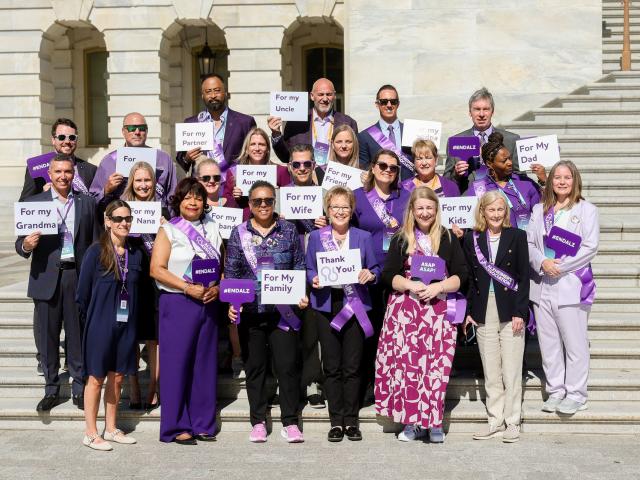
Washington, D.C., July 21, 2026 — The Alzheimer’s Association and the Alzheimer’s Impact Movement (AIM) celebrate the unanimous passage of the bipartisan Accelerating Access to Dementia & Alzheimer’s Provider Training (AADAPT) Act by the U.S. House of Representatives. The vote moves the bill one step closer to becoming law and to helping the millions of Americans living with Alzheimer’s who have yet to receive a diagnosis.
“Today’s vote is a meaningful step forward for every family that has struggled to get answers and every provider who has wanted to do more,” said Robert Egge, Alzheimer’s Association chief public policy officer and AIM president. “Through free, remote continuing education programs that connect primary care providers with dementia care experts, the AADAPT Act addresses one of the most persistent gaps in our healthcare system. We thank Reps. Balderson, Barragán, LaHood and Tonko for their leadership in introducing and advancing this bipartisan legislation.”
“Alzheimer’s disease impacts millions of Americans, and as more people are diagnosed with this devastating disease, we must ensure patients and families can access care and support as early as possible. The AADAPT Act strengthens and reauthorizes the Project ECHO program, giving primary care providers — especially those serving rural and underserved communities — the training and resources they need to recognize the signs of dementia earlier and deliver better care closer to home. I thank my House colleagues for supporting this legislation and joining me in helping equip frontline healthcare providers to better serve Americans living with Alzheimer’s and other dementias,” said Rep. Troy Balderson (R-Ohio).
“All too often, people with Alzheimer’s disease are diagnosed late, which can impact the effectiveness of their care,” said Rep. Nanette Barragán (D-Calif.). “My mother’s own primary care physician did not provide knowledgeable medical advice when she showed early signs. She is one of more than 7 million Americans who live with Alzheimer’s disease, and that number is expected to rise. I'm glad to see the House passed the AADAPT Act, a bipartisan bill I led with Representative Balderson, which can provide more specialized education, including training on Alzheimer’s, for primary care providers to take faster initiative. The Senate and the president now must take immediate action to get this bill signed into law so that Americans facing this devastating disease do not have to go longer without answers or support.”
“Alzheimer’s impacts countless individuals and families throughout America and Illinois’ 16th Congressional District,” said Rep. Darin LaHood (R-Ill.). “As co-chair of the Alzheimer's Working Group, I’ve been proud to advocate for legislation like the AADAPT Act to strengthen support for patients and ensure our local primary care providers have the specialized training they need to treat, diagnose and care for those living with Alzheimer’s and other forms of dementia. I thank my colleagues in the House for supporting this critical piece of legislation, and I urge my colleagues in the Senate to send the bill to the president’s desk so we can enhance the quality of care and strengthen our support for patients and their families.”
“Alzheimer's is a devastating disease that impacts nearly 427,000 individuals in New York State and more than 7 million people across the United States,” said Rep. Paul Tonko (D-N.Y.). “Throughout my time in Congress, I have been committed to improving care for aging Americans by championing efforts that support both individuals living with Alzheimer’s and their loved ones. Today, the House took a step forward to improve quality of care for patients with Alzheimer’s by passing the Accelerating Access to Dementia & Alzheimer’s Provider Training (AADAPT) Act. The AADAPT Act will close the gaps in dementia training by expanding access to virtual training opportunities, strengthening dementia education for primary care providers, and supporting earlier and more accurate diagnosis. I am proud to have sponsored this legislation and urge the Senate to move swiftly to pass this critical bill!”
Only half of those living with Alzheimer’s have received a diagnosis. In 85% of cases, the initial diagnosis is made by a primary care provider — yet most report they do not feel prepared to care for patients living with dementia. The AADAPT Act would expand capacity for health care providers to participate in structured virtual education programs focused on Alzheimer’s and dementia care, strengthening providers’ skills in detection, diagnosis, treatment and ongoing care. The bill is designed to reach rural and medically underserved areas, where primary care providers often face the greatest strain and many cases go undiagnosed.
“We are living through a pivotal moment in Alzheimer’s science — new treatments are reaching patients and new diagnostic tools are transforming early detection,” said Egge. “The AADAPT Act ensures the workforce is ready to deliver on that promise. The Alzheimer’s Association and AIM look forward to working with the Senate to advance this legislation and see it signed into law.”
The Alzheimer’s Association and AIM have worked alongside advocates and bipartisan congressional champions across the country to advance this legislation. The AADAPT Act was introduced in the House by Reps. Troy Balderson (R-Ohio), Nanette Barragán (D-Calif.), Darin LaHood (R-Ill.) and Paul Tonko (D-N.Y.), and in the Senate by Sens. Shelley Moore Capito (R-W.Va.), Amy Klobuchar (D-Minn.), Jerry Moran (R-Kan.), Cory Booker (D-N.J.), Dan Sullivan (R-Alaska), Andy Kim (D-N.J.), James Lankford (R-Okla.) and Maria Cantwell (D-Wash.).