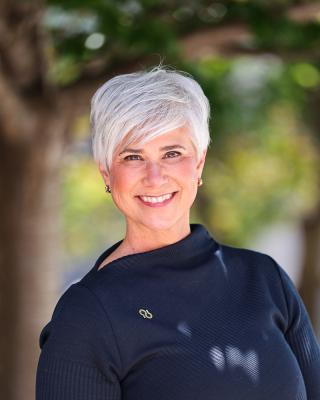
Beth McMullen
Each month, we’re featuring an advocate who engages with policymakers to ensure priorities that improve the lives of people impacted by Alzheimer’s and all other dementia remain top-of-mind in Congress.
After years of searching for answers, Karen Sandone’s husband, Anthony, was diagnosed with younger-onset Alzheimer’s in 2023. What followed was a new mission for Karen: sharing her family’s story with policymakers as an AIM advocate and building communities of caregivers and advocates along the way.
Her story is particularly powerful at this critical moment for the ASAP Act (H.R. 6130/S. 3267). The bipartisan bill would accelerate access to blood-based Alzheimer’s screening tests, helping more families get an earlier answer. It has strong support in the House and Senate and has cleared a unanimous committee vote, but it needs to pass in both chambers before the end of this Congress to become law. Throughout the fall, advocates across the country have raised their voices, recorded videos and kept the ASAP Act top of mind for policymakers.
For caregivers like Karen, the stakes are especially high. Nearly 13 million Americans care for a loved one with Alzheimer’s or another dementia, and the stretch before a diagnosis is often one of the hardest — families managing real changes without a name for them or a plan for what comes next. Earlier detection can also give caregivers more runway to arrange support and protect their own health before their role intensifies.
Karen and Anthony know that stretch well. They began seeing signs in 2020. Starting with a general neurologist, they were sent to look into sleep apnea and vitamin B12 deficiency. Karen reflects back, “All these things that obviously were not as serious” as what it turned out to be. All the while, the disease was progressing.
By May 2023, Anthony could no longer work. A PET scan that August led to an Alzheimer's diagnosis in September, and by then, Karen recalled, his disease had progressed and was “already close to moderate.”
That experience of delayed diagnosis is why Karen advocates so strongly for the ASAP Act. Today, fewer than 10% of people living with mild cognitive impairment ever receive a diagnosis. For families, a delayed diagnosis can mean missing the window when treatment can do the most. As Karen put it, “it’s all about timing, and the blood test is so important.”
Karen and Anthony were private about his diagnosis at first. But as her family began sharing their story on social media, the response grew quickly, and other caregivers started reaching out to her. “I was having trouble responding to so many caregivers who needed help,” said Karen.
As more caregivers reached out, she and three other women co-founded a caregiver support community. “There’s so many people out there that really need resources. It’s been very special,” Karen said.
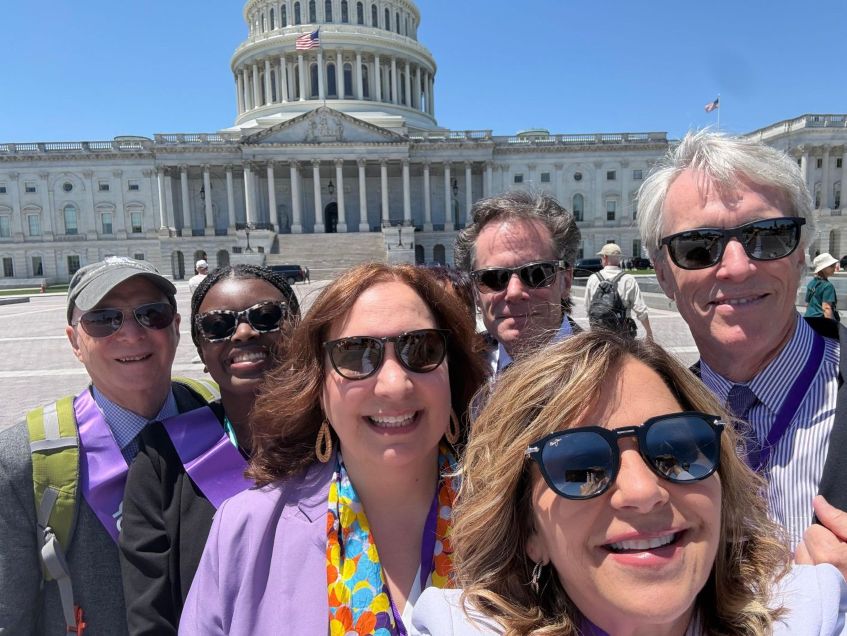
She has brought that same community-building spirit to her advocacy. At the AIM Advocacy Forum, Karen found a new circle of people who understand what her family is going through. “I’ve met a lot of great people who I’m in contact with,” Karen said. Now she is working to open that door for others, inviting members of her caregiver community to join her for meetings with local lawmakers. “I want them to get the feeling of what it’s like to do advocacy work, and then maybe they’ll join AIM or be part of it in the future,” she said.
When she first got involved, Karen remembers telling her story at one of her meetings at the AIM Advocacy Forum. While she was nervous, she came away feeling that “our story is powerful, and it does really catch attention.”
In both 2025 and 2026, Karen met with Rep. Brian Fitzpatrick (PA-01), a longtime champion for the Alzheimer’s community. Karen remembers that for one of these meetings he came out of another meeting to speak with her and her fellow advocates, and that she felt “very blessed and honored” that he “was willing to sit down with us and listen to my story.” Rep. Fitzpatrick has cosponsored many of AIM’s priority bills over the years, and he was among the first cosponsors of the ASAP Act and the first from Pennsylvania. Advocates like Karen — who share their stories and urge him to take action — help strengthen that commitment to the Alzheimer’s community.

In addition to her advocacy work, Karen was also recently elected to the board of the Association’s Southeastern Pennsylvania chapter, where, she said, her “major goal is to emphasize more resources for younger-onset caregivers.”
When Karen started advocating, it was for her husband Anthony. “But now I’m advocating not just for him, but for other families who go through this,” said Karen. This National Family Caregivers Month, her story is a reminder that caregivers are among the strongest voices for change. As Karen put it, “Our platform is strength in numbers.”
With the end of this Congress approaching, there is no better time to add your voice. Become an advocate and advance the ASAP Act today and urge your members of Congress to help move it across the finish line.