Beth McMullen
Each month, we’re featuring an advocate who engages with policymakers to ensure priorities that improve the lives of people impacted by Alzheimer’s and all other dementia remain top-of-mind in Congress.
Growing up, Sean Terwilliger’s family taught him the importance of raising your voice. Less than two years after learning he had Alzheimer’s, Sean has made his voice heard in congressional offices on Capitol Hill, at Massachusetts State Advocacy Day and in the Massachusetts-New Hampshire Chapter’s Early-Stage Advisory Group.
“This is truly me discovering that I had a voice that was needed,” said Sean.
Sean’s Alzheimer’s journey began long before his diagnosis. In 2018, he experienced a transient ischemic attack (TIA), or a “mini-stroke.” Sean became concerned about his cognitive health during his recovery. About a year after the TIA, Sean spoke to his doctor about difficulty finding words, forgetting appointments and stating wrong numbers.
“I just wanted one of those baseline tests that let me see what my cognitive abilities are now, so that I could take the test again in five or 10 years, and see what’s going on. It took six years to get that test.”
It wasn’t until Sean and his wife, Wendy, moved to Massachusetts that a physician finally listened. He narrowly failed a standard cognitive screening — missing the cutoff by one point — and was referred to a neurologist. In July 2024, six years after he began his journey, Sean received his Alzheimer’s diagnosis.
Sean’s diagnosis experience is precisely the kind of story that makes the case for the bipartisan Alzheimer’s Screening and Prevention (ASAP) Act, which would make Medicare coverage of routine dementia blood tests possible. Sean himself wonders how his experience could’ve been different if the ASAP Act had been enacted at the time.
“If there was a routine and inexpensive blood test, perhaps when I had been presenting with odd symptoms I might have learned I had Alzheimer’s earlier and been able to join clinical research trials,” Sean said. “Now that there are treatments on the market, we can get people on this disease-modifying maintenance right away.”
After processing his diagnosis over a few months, which included starting a blog and writing a memoir, Sean saw an Alzheimer’s Association Facebook ad looking for early-stage advisors. He was selected to join the local group. He then met with his local chapter advocacy staff in Massachusetts and quickly signed up to become an advocate.
“That was me jumping on the train, and finding purpose,” said Sean. “Now I live for it.”
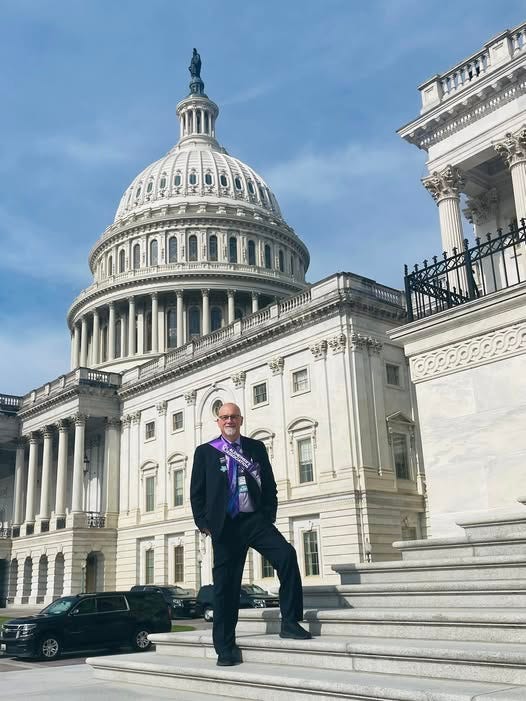
Sean’s personal experience and powerful storytelling brought him to the AIM Advocacy Forum. Last year, he met with the offices of Rep. Richard Neal and Sens. Ed Markey and Elizabeth Warren. He is looking forward to attending again next month.
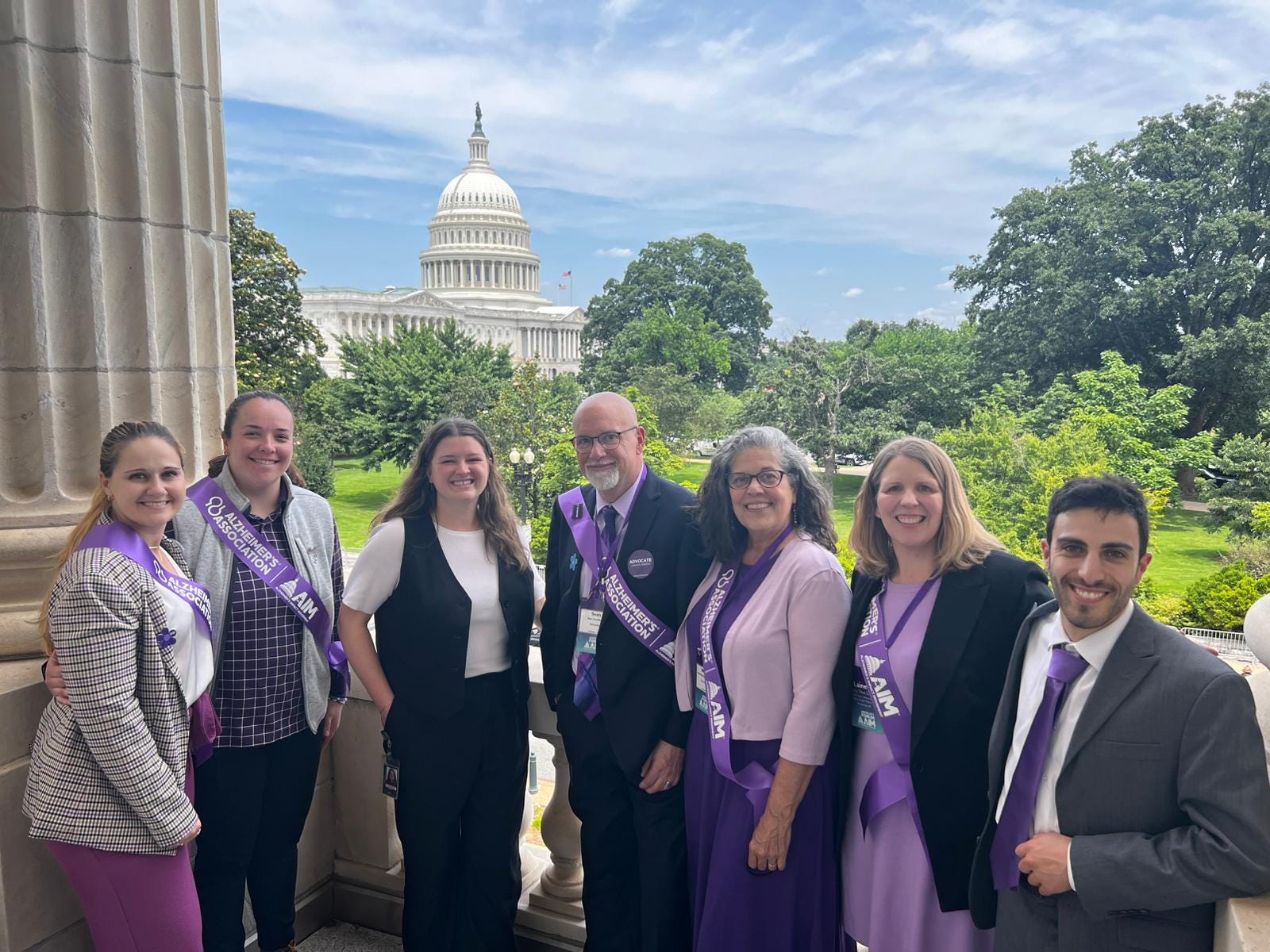
A distinct memory from the Forum that Sean carries with him is sitting on a balcony overlooking the Capitol with a member of Rep. Neal’s staff. “I remember saying ‘I’m on Leqembi. It slows [progression of the disease] down by 30%. That’s not enough. I want to be cured,”’ said Sean. “I don’t feel it’s wrong of me to stand up in front of a room full of people and say, ‘I want to be done with this.’”
This was the first time Sean voiced his needs in this way, and it’s become part of what he shares with every policymaker he meets.
The Advocacy Forum didn’t just provide Sean an outlet to advocate for himself and others living with Alzheimer’s, it gave him a sense of community. “With Alzheimer’s you really feel alone,” said Sean. “Seeing all of these people who were so dedicated to a cause that was starting to mean so much to me really made me feel like this is doable. This is a movement that I absolutely want to be a part of.”
Despite being relatively new to advocacy, Sean has already made strong connections with his fellow Bay State advocates and advocates from all over the country. And he’s looking forward to reuniting with them at the upcoming Advocacy Forum.
In addition to his advocacy, Sean is continuing to discover new passions. An avid musician, Sean can play guitar, bass and saxophone. Due to tremors related to Alzheimer’s, Sean can’t play the guitar as well as he used to, but he’s found another musical outlet.
“My wife and I were driving down the road one day, and this drum set was just sitting in somebody’s trash,” recalled Sean. They grabbed it, and drumming has since become part of Sean’s brain health routine.
“I don’t even think pre-Alzheimer’s I would have been a drummer, but it is something that I can train four limbs to do four different things at the same time. That is brain health.”
Meeting with elected officials is often intimidating for new advocates. Sean has always considered himself a storyteller and sees advocacy as a natural extension of this. His affinity for trying new things — Sean and his wife have moved 19 times since 2006 — certainly helped as well.
For those who might be curious about advocacy but aren’t sure where to start, Sean’s message is straightforward. “It could be the best thing you’ve ever done,” said Sean. “It is incredibly important work… and you’re doing it with people who genuinely care about you and the process that you’re going through. It doesn’t mean you have to fly down to D.C. — it could be writing a letter to the editor or going to a town hall meeting. It’s all part of the big picture.”
Join Sean in the fight to end Alzheimer’s by becoming an advocate today.